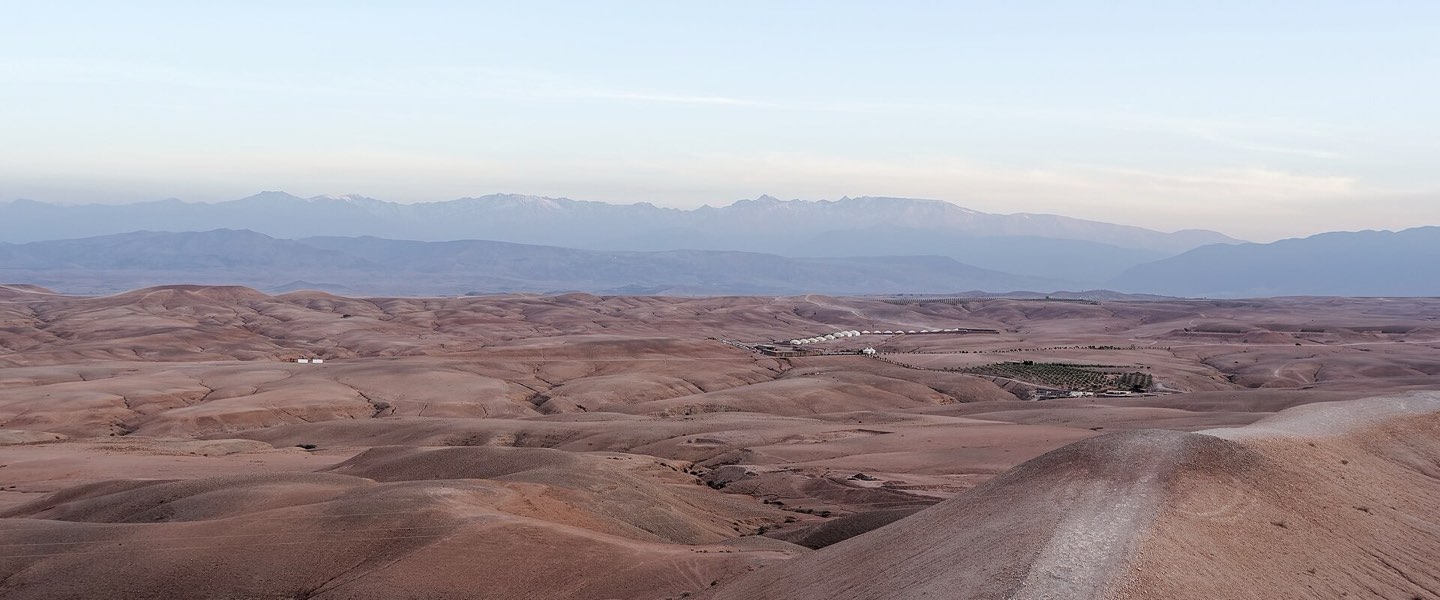
Agafay desert photography: the best light, and the drone question
Agafay desert photography is about two short windows: the hour after sunrise and the hour before sunset, when low light brings out every ridge of the stony hills, then the afterglow until dark. Here that means sunset at 17:31 and dark at 17:58 on 15 December, sunset at 19:39 on 15 June. Leave the drone at home: Moroccan customs hold one that arrives without an import licence for up to 45 days.
Some links on this page are affiliate links: the guide earns a commission when you book through them. The partner sets the price; the guide adds no fee. How this works
Your light on any date
Put in the day you will be in Agafay. The drawing shows that day from early morning to late evening: the gold bands are the soft hours with the sun low, the ochre between them is the hard light of the middle of the day, and the pale strip after sunset is the afterglow before dark. Times are in Morocco's clock time, which has been UTC+0 since 20 September 2026 at 02:00.
15 December 2026
- Sunrise
- 7:24
- Sunset
- 17:31
- Dark (end of civil twilight)
- 17:58
- Morocco's clock that day
- UTC+0
| Date | Sunrise | Sunset | Dark |
|---|---|---|---|
| 15 December 2026 | 7:24 | 17:31 | 17:58 |
| 15 January 2027 | 7:33 | 17:52 | 18:18 |
| 15 February 2027 | 7:15 | 18:20 | 18:44 |
| 15 March 2027 | 6:43 | 18:41 | 19:05 |
| 15 April 2027 | 6:05 | 19:01 | 19:26 |
| 15 May 2027 | 5:37 | 19:22 | 19:49 |
| 15 June 2027 | 5:28 | 19:39 | 20:07 |
| 15 July 2027 | 5:38 | 19:39 | 20:06 |
| 15 August 2027 | 5:58 | 19:16 | 19:42 |
| 15 September 2027 | 6:17 | 18:39 | 19:03 |
| 15 October 2027 | 6:36 | 18:01 | 18:26 |
| 15 November 2027 | 7:00 | 17:34 | 18:00 |
The two soft hours, and the short afterglow
Agafay is a stone desert of bare hills, gullies and tracks with almost nothing growing on it. In the middle of the day the sun stands high, the shadows shrink under every stone and the hills flatten into one pale brown. When the sun is low, each ridge throws a long shadow, the ground turns red-brown and the texture comes back. That is why the hour after sunrise and the hour before sunset make most of the good pictures here.
The evening hour is the easy one to catch, because the sunset tours are timed for it. The morning hour is quieter, with the camps still asleep and no tours on the tracks. If you stay overnight, set an alarm for sunrise at 7:24 in mid-December or 5:28 in mid-June.
After sunset the colour lasts until the end of civil twilight: on 15 December from 17:31 to 17:58, on 15 June from 19:39 to 20:07. It is short, so be ready before it starts. This is the time for silhouettes: a rider, a camel or a tent dark against a bright sky. The week-by-week sunset table, with the latest time to leave the medina for a sunset ride, is on Agafay sunset times.


What to point the camera at in a stone desert
Without sand dunes to frame, Agafay rewards a different eye. Four subjects carry most pictures.
Ridges and tracks
The dirt tracks that wind across the plateau give a picture its line. Climb a little above one, put the low sun to the side, and the track and the ridges behind it stack up in layers towards the horizon.
Camel strings
A line of camels crossing open ground reads at any size. Shoot it side-on so each animal stands clear, and leave space ahead of the string. The handlers walk with them; ask before you photograph a handler up close.
Silhouettes after sunset
A sunset tour such as the GetYourGuide sunset camel ride leaves you on open ground as the sky lights up. Expose for the bright sky and let the ground go black. People, camels and tents on a ridge line become clean shapes. A phone does this well if you tap the sky to set the exposure.
Camps going dark
Lanterns and fires against a deep blue sky make the camp pictures, in the few minutes when there is still colour in the sky. After that the stars take over, if the moon and the cloud allow; the Agafay at night page covers the dark hours.


The camel rides that get you into these pictures, and how to tell a well-kept animal, are on camel rides in Agafay. Where the camps, the villages and the tracks sit on the plateau is on the Agafay map.
The High Atlas on the horizon: a maybe, not a promise
The mountains south of Agafay can appear as a pale line along the horizon, as in the photographs on this page, or vanish altogether in haze and dust. Nobody can tell you in advance which you will get. Here is who says what.
The camp operator Scarabeo Camp states
Its Stone Camp offers a view of the Atlas Mountains.
The operator site Visit Agafay Desert states
Snow-capped peaks can be seen in the distance in some months of the year.
For a mountain picture, a long lens helps more than a wide one: it pulls the range up behind the hills. A clear day is your best chance. If the range matters to you, look at the weather for your date and keep a second morning free.
Drones: what the rules mean for your bag
The drone rules are in the box beside the light clock above, each in the words of the body that states it. In practice they come to this: a drone is not something you can simply pack and fly. Bringing one in needs an import licence from the department in charge of Foreign Trade, and customs hold a drone that arrives without it. Flying is a second permission: the UK FCDO names the Directorate General for Civil Aviation (DGAC) as the body to ask.
The state's procedures portal, Idarati, lists a customs authorisation for the temporary admission of drones, but no civil aviation procedure for flying one. Unless you travel for work with both permissions in hand before you leave, leave the drone at home. A camera with a long lens, or a walk up the nearest ridge, gets you the high view the plateau allows.
Arriving with a drone and no licence
45 daysheld by customs at most, then treated as abandoned
Photographing people, camps and villages
Ask first, every time. The UK FCDO advises asking permission before photographing people, especially children, and states that photographs near sensitive political or military sites are illegal in Morocco. A smile and a gesture at the camera is enough to ask; a shake of the head is an answer, and the picture is not taken.
On the drive out you pass through Amazigh villages, the douars of the plain and the foothills. They are people's homes, not a set. Photograph the landscape from the road, and if you want a portrait, ask the person and show them the picture after. Camel handlers, drivers and camp staff are working; ask them too, and do not hold up the ride for a shot.
Camps are private ground. The tents and the tables are yours to photograph; other guests are not part of your picture, so frame them out or ask.
Kit for dust, cold and the dark
Stone desert is kinder to cameras than sand, but the tracks are dusty and quads and cars raise more. Change lenses inside a car or a tent, not in the open, and carry a blower and a soft cloth. A phone in a pocket picks up fine grit; wipe the lens before each set.
The afterglow and the camp lights call for a steady camera: a small tripod or a beanbag on a rock does it, and a phone's night mode helps. Evenings cool fast after sunset, and batteries drain in the cold, so keep a spare warm in an inside pocket in winter. What to wear for a winter evening is on the page on what to wear in Agafay. Bring a torch for the walk back from the ridge: once the twilight ends the ground is stony and dark.
Getting there in time for the light
For the evening, any sunset camel ride puts you in the right place at the right hour. The Marrakesh: Agafay Desert Sunset, Camel Ride, and Dinner Show is on GetYourGuide at USD 12 per person on 14 November 2026, for 4.5 hours, with a camel ride of 20 minutes; the listing shows 1,165 reviews. On your own, leave the medina by 16:01 on 15 December to be riding at sunset; the sunset finder gives the time for any date.
For the morning, the Camel Ride at Sunrise with Breakfast in Agafay Desert on Viator lists from USD 33.82 per person on the same date with a start time of 6:00. That fits winter, when the sun rises at 7:24 on 15 December; on 15 June it rises at 5:28, so ask for the summer start time. A night in a camp is the simplest way to have both soft hours, the evening and the next morning.
Questions people ask
When is the best light for photos in Agafay?
The hour after sunrise and the hour before sunset, when the low sun brings out the texture of the stony hills, then the short afterglow until dark. On 15 December sunset is at 17:31 and it is dark by 17:58. The light clock on this page gives sunrise, sunset and dark for any date.
Can I bring a drone to Agafay?
Moroccan customs prohibit importing a drone without an import licence from the department in charge of Foreign Trade, and hold one that arrives without it for at most 45 days. The UK FCDO says flying one also needs permission from the Directorate General for Civil Aviation (DGAC). Without those papers, leave it at home.
Can you see the Atlas Mountains from Agafay?
Sometimes. Operators such as Scarabeo Camp state their camps have a view of the Atlas Mountains. On a clear day the range shows as a pale line on the horizon; in haze or dust it disappears. Plan for the desert, and take the mountains as a bonus.
Can I photograph people in the villages and camps?
Ask first. The UK FCDO advises asking permission before photographing people, especially children, and photographs near sensitive political or military sites are illegal. In the villages on the way and in the camps, a gesture at the camera is enough to ask, and a no means no picture. Other guests at a camp are best left out of the frame.
Do I need a tripod for Agafay photography?
Not for the daylight pictures. For the afterglow after sunset and the camp lights, a small tripod or a beanbag helps keep the camera still; a phone's night mode works for snapshots. For the night sky a tripod is close to essential, and the darkest corner of the camp, away from the fire and the stage, works best.
Sources
- Smartraveller states drone use is heavily controlled in Morocco and advises seeking Moroccan Government approval before entering the country with a drone. Smartraveller (DFAT), Morocco travel advice, Local laws, 29 July 2026.
- The US Department of State states drones are prohibited in Morocco without prior government authorisation and are confiscated; its wording. US Department of State, Morocco country information, Safety and security, 13 August 2026.
- At the Agafay commune centroid (31.4872°N, 8.1971°W) sunset on 21 March 2026 is, per the US Naval Observatory in UTC: 18:45 UTC. US Naval Observatory, Astronomical Applications API (rstt/oneday), computed with tz=0 (UTC), 21 March 2026.
- At the Agafay commune centroid (31.4872°N, 8.1971°W) sunset on 21 June 2026 is, per the US Naval Observatory in UTC: 19:41 UTC. US Naval Observatory, Astronomical Applications API (rstt/oneday), computed with tz=0 (UTC), 21 June 2026.
- At the Agafay commune centroid (31.4872°N, 8.1971°W) sunset on 21 December 2026 is, per the US Naval Observatory in UTC: 17:34 UTC. US Naval Observatory, Astronomical Applications API (rstt/oneday), computed with tz=0 (UTC), 21 December 2026.
- At the Agafay commune centroid (31.4872°N, 8.1971°W) civil twilight ends on 21 March 2026, per the US Naval Observatory in UTC, at 19:09. US Naval Observatory, Astronomical Applications API (rstt/oneday), computed with tz=0 (UTC), 21 March 2026.
- At the Agafay commune centroid (31.4872°N, 8.1971°W) civil twilight ends on 21 June 2026, per the US Naval Observatory in UTC, at 20:09. US Naval Observatory, Astronomical Applications API (rstt/oneday), computed with tz=0 (UTC), 21 June 2026.
- At the Agafay commune centroid (31.4872°N, 8.1971°W) civil twilight ends on 21 December 2026, per the US Naval Observatory in UTC, at 18:01. US Naval Observatory, Astronomical Applications API (rstt/oneday), computed with tz=0 (UTC), 21 December 2026.
- Decree no. 2.26.530 of 25 June 2026 returns Morocco's legal time to Greenwich Mean Time at 2:00 on Sunday 20 September 2026 by setting clocks back 60 minutes 20 September 2026 at 02:00. Kingdom of Morocco, Bulletin officiel (Arabic edition) no. 7521, 13 Muharram 1448 (29 June 2026), p. 3768: Decree no. 2.26.530 of 9 Muharram 1448 (25 June 2026) on legal time, 25 June 2026.
- Since 20 September 2026 Morocco's legal time is Greenwich Mean Time (UTC+0), as set by royal decree 455.67 of 2 June 1967 and restored by decree no. 2.26.530. Kingdom of Morocco, Bulletin officiel (Arabic edition) no. 7521, 13 Muharram 1448 (29 June 2026), p. 3768: Decree no. 2.26.530 of 9 Muharram 1448 (25 June 2026) on legal time, 25 June 2026.
- Moroccan customs (ADII) state that importing remote-controlled unmanned flying objects (drones, model aircraft) is prohibited unless the traveller presents an import licence from the department in charge of Foreign Trade (the Idarati portal separately lists a Customs authorisation for the temporary admission of drones, 60 days' processing, free); issuing body Foreign Trade. Administration des Douanes et Impôts Indirects (ADII), Particuliers, Etrangers en visite au Maroc (Q&A).
- Moroccan customs (ADII) state that a drone arriving without an import licence is held in deposit pending regularisation for at most this many days, after which it is treated as abandoned 45. Administration des Douanes et Impôts Indirects (ADII), Particuliers, Etrangers en visite au Maroc (Q&A).
- France Diplomatie states bringing a drone into Morocco is totally forbidden except with prior authorisation for specific professional needs. France Diplomatie (MEAE), Conseils aux voyageurs Maroc, Entrée / séjour, 15 September 2026.
- France Diplomatie states that using a drone in Morocco without authorisation can lead to prosecution. France Diplomatie (MEAE), Conseils aux voyageurs Maroc, Entrée / séjour, 15 September 2026.
- The UK FCDO states that to fly a drone brought to Morocco you must get permission from the Directorate General for Civil Aviation (the Idarati procedures portal lists no DGAC drone-flight procedure, only a Customs temporary-admission authorisation); body DGAC. UK FCDO, Morocco travel advice, Safety and security, 19 August 2026.
- The UK FCDO states it is illegal in Morocco to take photographs near sensitive political or military sites and advises asking permission before photographing people, especially children. UK FCDO, Morocco travel advice, Safety and security, 19 August 2026.
- Wikidata places the Agafay Desert item (Q86301994) at latitude 31.48396, longitude -8.19105. Wikidata, item Q86301994 'Agafay Desert'.
- The camp operator Scarabeo Camp states its Stone Camp offers a view of the Atlas Mountains. Scarabeo Camp, FAQs.
- The operator site Visit Agafay Desert states snow-capped peaks can be seen in the distance from Agafay between December and March December to March. visitagafaydesert.com, Agafay Desert guide.
- Sunrise, sunset and civil dusk at Agafay, in Morocco's legal time. NOAA solar calculation for the Agafay Desert point (31.48396°N, 8.19105°W, Wikidata Q86301994), clock times in Morocco's legal time (time zone Africa/Casablanca; UTC+0 since 20 September 2026 under decree 2.26.530)
- Tour prices, times and the drive to Agafay. Partner listings on GetYourGuide, Viator and Klook with the date of each price, in the partner's currency; transfer times as the operators and the Moroccan National Tourist Office state them
- Leave-by times from the day-shape planner. The planner's rules over the partner itineraries' stated minutes, the drive to Agafay as operators state it (40 to 60 minutes) and the NOAA sunset at the Agafay Desert point in Morocco's legal time
Photographs
- Agafay with the High Atlas behind. Photo: Jakub Hałun / Wikimedia Commons, CC BY 4.0
- Agafay with the High Atlas behind. Photo: Jakub Hałun / Wikimedia Commons, CC BY 4.0
- Agafay with the High Atlas behind. Photo: Jakub Hałun / Wikimedia Commons, CC BY 4.0
- A camel caravan at sunset. Photo: Schiplagerheide / Wikimedia Commons, CC BY 4.0
